
Home/Wall projects/Kitchen Walls in Linen Fold Satin, With an Ochre Cooker Band
Kitchen Walls in Linen Fold Satin, With an Ochre Cooker Band
Published 24 September 2026Wall projectKitchenOld paint#E7DFD2 · #D9A44A
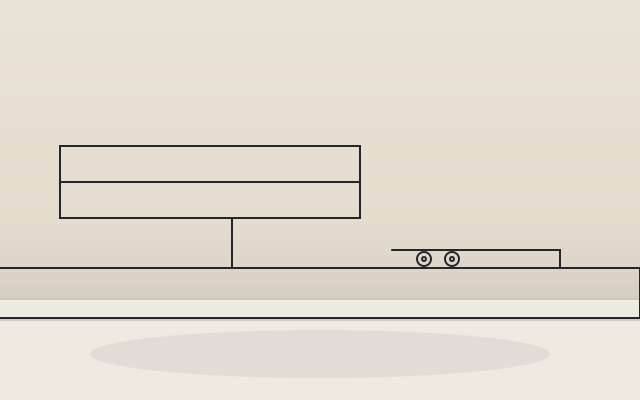
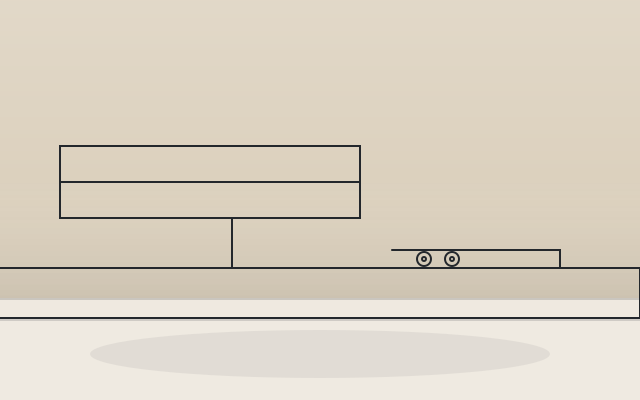
Finish: #E7DFD2 + #D9A44A. The toggle shows the same wall in its previous colour.
Prep sequence
- Degrease 600mm either side of the hob and above the bin with a concentrated kitchen degreaser, twice
- Rinse and let dry 1 hour — trapped moisture under satin blisters
- Sand the whole splash-adjacent zone with P180 to give the satin something to key into
- Caulk the joint where wall meets worktop with a heat-resistant acrylic, not silicone
- Mask the worktop edge and the underside of wall units
Tools
- 4in mini roller, 10mm sleeve
- 2in stubby brush
- degreaser concentrate
- P180 sanding sponge
- heat-resistant acrylic caulk
- masking film and tape
Kitchens need two different paints in one room. Linen Fold at LRV 74 in satin handles steam and grease on the field walls; a 600 mm band of Ochre Field behind the hob gives the eye somewhere to land and hides the fine spatter that no amount of cleaning removes.
- Coats
- 2
- Sheen
- Satin · 34u
- Substrate
- Old paint
- Touch dry
- 2 hours
- Recoat after
- 4 hours
- VOC
- 40 g/L
- Full cure
- 14 days
Two zones, two problems
A kitchen wall fails in two places and for two different reasons. Around the hob and above the bin, the failure is chemical — airborne grease polymerises onto the film and turns a matte surface into a tacky, yellowing skin. Around the window and sink, the failure is physical — condensed steam and repeated wiping burnish whatever finish is there.
Treating the room as one continuous surface guarantees one of those two failures. Splitting it into a field colour and a 600 mm cook band costs one extra tin and about forty minutes.
Why Linen Fold for the field
Linen Fold (#E7DFD2, LRV 74) is a warm off-white with a very slight beige-grey cast. It reflects enough light to keep a north-facing kitchen usable in winter, but it does not read as clinical white next to oak or walnut worktops. At LRV 74, it also sits far enough below a white ceiling to avoid the flat, boxed-in look you get when walls and ceiling are both at LRV 88 or higher.
Why Ochre Field for the band
Ochre Field (#D9A44A, LRV 42) behind the hob has nothing to do with style. A mid-tone warm colour absorbs the small spatter that lands on the wall during frying, whereas an off-white makes every dot a visible speck for the four or five days until the next clean. It also frames the cooking area, which is useful in an open-plan layout where the kitchen needs to read as one zone.
The band should be 600 mm above the worktop and stop exactly at a wall unit or a vertical edge. An arbitrary stop in the middle of an open wall looks like a mistake; stopping under an extractor or at the end of the run looks deliberate.
Degreasing is not optional
- Spray concentrated kitchen degreaser on the zone 600 mm either side of the hob and above the bin. Leave it the full dwell time on the bottle — usually five minutes — then wipe with a clean cloth.
- Repeat with a fresh cloth. The first pass lifts the film, the second lifts what the first smeared around. If the cloth comes away grey, do it a third time.
- Rinse with clean water and let the wall dry a full hour. Satin applied over trapped moisture blisters within a week.
- Sand the splash zone with P180. Satin needs a mechanical key far more than matte does, because it forms a tighter, less permeable film.
- Caulk the wall-to-worktop joint with a heat-resistant acrylic caulk. Never use silicone here if you plan to paint it — paint will not stick to silicone, and silicone will not accept a topcoat anywhere it has touched.
- Mask the worktop edge and the underside of the wall units, and leave a 20 mm gap at the top so the paint line stays hidden behind the unit.
Application and the re-coat trap
Cut in with a 2 in stubby brush, then roll with a 4 in mini roller in 600 mm squares. Small rollers suit kitchens because the walls are broken up by units, and a 9 in sleeve is too big to control between a splashback and a cupboard return.
| Stage | At 20 C / 50% RH | At 30 C / 40% RH |
|---|---|---|
| Touch dry | 2 hours | 1 hour |
| Recoat | 4 hours | 3 hours |
| Handle / wipe-clean | 7 days | 5 days |
| Full cure | 14 days | 10 days |
The trap is humidity, not just temperature. Satin in a kitchen dries from the surface down, so the film skins over long before it is recoat-ready underneath. Recoat at four hours, not at the two-hour touch-dry point, and never paint with the extractor off — airflow is what sets the film.
Material for a typical 3 x 2.6 m galley kitchen, field colour on both long walls, band behind the hob, both sides of one window: roughly 6 litres of satin, 1 litre of ochre, 1 tube of caulk.
What matters here
- Split the kitchen into a field colour and a 600 mm cook band; one paint cannot do both jobs.
- Degrease twice with a fresh cloth each time, then let the wall dry a full hour.
- Satin needs a P180 key — it does not bond to a glossy, unsanded surface.
- Caulk the worktop joint with heat-resistant acrylic, never silicone.
Before you start Older paint may contain lead: test before sanding, burning or dry-scraping, and follow your local regulations for removal. Everything on this site is general trade information, not a professional specification or a safety assessment for your building.