
Home/Wall projects/Living Room Ochre Accent Wall on Old Paint
Living Room Ochre Accent Wall on Old Paint
Published 14 September 2026Wall projectLiving roomOld paint#D9A44A · #E7DFD2
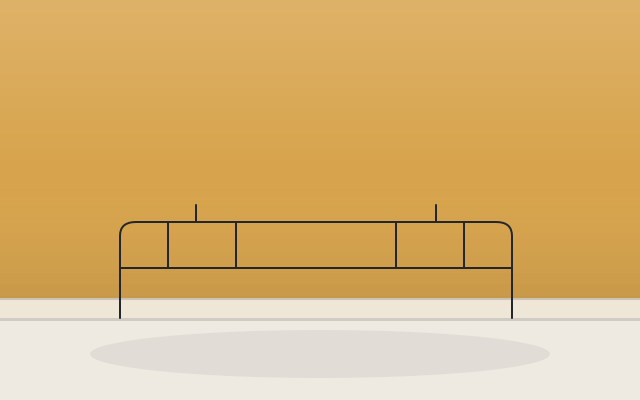
Finish: #D9A44A + #E7DFD2. The toggle shows the same wall in its previous colour.
Prep sequence
- Mark the accent wall boundary with a laser line before taping — do not trust the corner to be plumb
- Wash with sugar soap and rinse
- Sand the wall lightly with P180 to knock back the old sheen
- Spot-prime any bare patches or filled holes with the ochre itself, thinned 10%
- Tape the corner with low-tack tape and remove within 24 hours
Tools
- 9in roller, 12mm sleeve
- 38mm sash brush
- laser level or 1.2m spirit level
- low-tack tape
- P180 sanding sponge
- paint stirrer
One wall in Ochre Field at LRV 42, three in Linen Fold at LRV 74. The 32-point split does the work that a feature wallpaper used to do, without the pattern-matching problem when the wall is not plumb. The trick is entirely in the prep: old paint holds an accent colour unevenly unless the sheen is broken first.
- Coats
- 2
- Sheen
- Matte · 2u
- Substrate
- Old paint
- Touch dry
- 1 hours
- Recoat after
- 4 hours
- VOC
- 22 g/L
- Full cure
- 21 days
The 32-point rule
Accent walls fail when the contrast is wrong, not when the colour is wrong. Below about 20 LRV points the accent reads as a slightly different white from across the room, which looks like a mis-tint rather than a decision. Above about 45 points the wall stops being a wall and starts being a rectangle pasted onto the room.
The 20-45 band is where the accent reads as intentional. Ochre Field at LRV 42 against Linen Fold at LRV 74 is a 32-point split — comfortably in the middle, and it still works at night when the ceiling light drops the effective contrast by roughly a third.
Which wall
- The wall behind the sofa, if the sofa is under 2.2 m. Wider sofas swallow a narrow accent wall.
- The chimney breast, if there is one. It already has edges, so the colour has somewhere to stop.
- Never the wall opposite the main window in a north-facing room. An LRV 42 wall opposite the only light source reads almost black at 4pm.
Breaking the old sheen
This is the part that decides whether the job looks professional. Acrylic matte over a burnished old emulsion does not adhere evenly: it grips the flat areas and slides on the polished ones, and the result is a blotchy finish that looks like the paint is still wet.
- Laser a vertical line 2 mm outside the corner you are keeping pale, and tape to that line rather than to the corner. Interior corners are almost never plumb, and a tape line that follows a 6 mm lean is visible from the sofa.
- Wash the accent wall with sugar soap, rinse with clean water, dry 1 hour.
- Sand the whole wall with P180 on a sponge. You are not removing paint, only dulling the sheen. Anywhere that still reflects a window is not sanded enough.
- Spot-prime bare filler and any sanded-through patches with the ochre thinned 10%. A white primer under ochre will show as a grey patch on the second coat.
- Remove the tape within 24 hours of the final coat, pulling at 45 degrees back over itself. Tape left for a week can lift the new film edge.
Two coats, matte, in the right order
Cut in the ceiling line and the tape edge first, then roll in 1 m squares from the ceiling down. With LRV 42 matte, roller lap marks are the main risk: the film is thin and dries fast, so a partially dry edge will not blend.
- Keep a wet edge: never let a square sit more than 3-4 minutes before the next one joins it.
- Do not stop mid-wall. If you must break, break at a corner or under a picture rail.
- Add 5% water to the first coat only. Ochre pigments are heavy and the first coat over sanded old paint will drag.
- Recoat after 4 hours at 20 C, 8 hours at 12 C. Do not judge by touch — matte feels dry long before it is.
What it costs
One 3.4 x 2.4 m accent wall, two coats: about 2 litres of ochre, plus roughly 250 ml of the field colour for the touch-in at the ceiling line where the cut-in always creeps. Buy the field colour in a 1 litre tin rather than opening the 5 litre you used for the other three walls — an opened tin skins over in three weeks.
Matte at LRV 42 also shows scuffs. Keep a small jar of the ochre for touch-in, and accept that a matte accent wall behind a sofa needs a touch-up roughly twice a year.
What matters here
- Keep accent contrast between 20 and 45 LRV points or the wall reads as a mis-tint.
- Sand old paint to break the sheen, or the new matte coat goes blotchy.
- Tape to a laser line, not to the corner — interior corners are rarely plumb.
- Never put an LRV 42 accent opposite the only window in a north-facing room.
Before you start Older paint may contain lead: test before sanding, burning or dry-scraping, and follow your local regulations for removal. Everything on this site is general trade information, not a professional specification or a safety assessment for your building.