
Home/Wall projects/Living Room Media Wall in Slate Ink, Eggshell on Old Paint
Living Room Media Wall in Slate Ink, Eggshell on Old Paint
Published 24 October 2026Wall projectLiving roomOld paint#3E4A52 · #D9CBB6
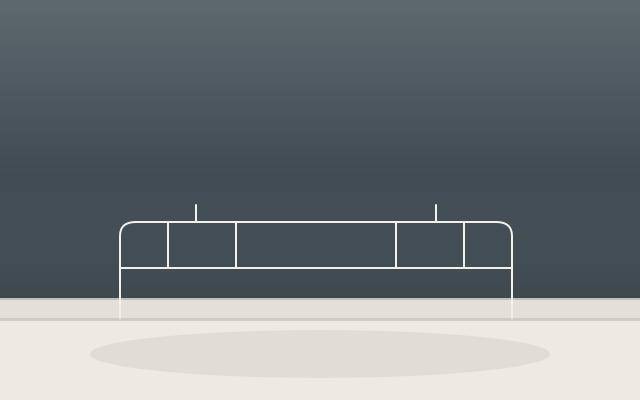
Finish: #3E4A52 + #D9CBB6. The toggle shows the same wall in its previous colour.
Prep sequence
- Wash the wall with sugar soap to remove the film that builds up behind a TV
- Sand with P180 to dull the old sheen
- Fill and spot-prime the old bracket holes
- Mark the TV centre line and the trunking route in pencil before painting so the dark tone stays uninterrupted
- Tape the ceiling line only — an LRV 7 wall shows every tape ridge if you tape the corner too
Tools
- 4in mini roller, 10mm sleeve
- 9in roller for the field wall
- 2in angled brush
- P180 sponge
- low-tack tape
- cable trunking and a chalk line
Slate Ink at LRV 7 turns a TV wall into a dark plane that swallows the screen's own glow and stops the black rectangle from looking like a hole punched in a pale room. Two coats, eggshell for wipeability, and one cable route planned before the first roller goes in.
- Coats
- 2
- Sheen
- Eggshell · 8u
- Substrate
- Old paint
- Touch dry
- 2 hours
- Recoat after
- 4 hours
- VOC
- 28 g/L
- Full cure
- 14 days
What a dark media wall does
A television on a pale wall is a black rectangle surrounded by glare. On an LRV 7 wall the same screen has almost no contrast against its background at the edges, so the eye reads the picture rather than the box. The effect is strongest when the wall behind the screen is at least 1.5 m wider than the screen on each side, which is why a media wall normally wants three or four times the screen area in dark paint.
The cost is that a very dark wall reflects. Not light — itself. At LRV 7 any surface irregularity shows as a sheen variation long before it shows as a shadow, which is why the prep on this job is entirely about flatness.
Eggshell rather than matte
| Reason | Detail |
|---|---|
| Fingerprints | The area under a wall-mounted screen is touched constantly when cables are swapped |
| Cleaning | Dust on a matte dark wall smears instead of wiping off |
| Reflection | Eggshell's 8-10 unit gloss still reads as flat on an LRV 7 base, unlike satin |
Chalkier tones matter here too. Slate Ink (#3E4A52, LRV 7) has a blue-grey cast rather than a neutral one, so under warm room lighting it does not go muddy brown the way a pure neutral dark does. The adjacent three walls in Warm Plaster (#D9CBB6, LRV 61) give a 54-point split — high, but acceptable on a single wall that is already defined by the furniture in front of it.
Prep is about flatness
- Wash the wall with sugar soap. The film that builds up behind a television is a mix of cooking volatiles and dust, and it is greasier than it looks.
- Sand the whole wall with P180 to dull the old sheen. On an LRV 7 finish, an unsanded glossy patch shows as a lighter bloom in the middle of the wall.
- Fill the old bracket holes, sand flush, spot-prime with the Slate Ink thinned 10%. A white spot primer under a dark wall is visible through two coats.
- Check flatness with a torch at 15 degrees. Fix anything you find now; a dark eggshell will not hide it.
- Mark the cable route in pencil and fit the trunking before painting. Painting around a surface-mounted cable run is the fastest way to make a deliberate dark wall look improvised.
Application
Cut in at the ceiling line only. Do not tape the vertical corners: an LRV 7 film at a corner edge forms a visible ridge when the tape comes off, and at this darkness the ridge reads as a light line.
- Coat 1 thinned 5%, applied with a 9 in roller in 1 m squares. A dark first coat over a mid-tone wall always looks worse than the wall it is covering.
- Recoat at 4 hours at 20 C. Do not roll the second coat over a first coat that is still tacky; dark pigments drag and leave streaks.
- Coat 2 neat. Lay off downwards and do not go back over an area that has started to flash.
- Use a 4 in mini roller behind the trunking and in the reveal, where a 9 in sleeve cannot reach without hitting the ceiling.
Touch-up and the reason to keep a tin
An LRV 7 eggshell shows touch-ups more than any other finish, because the repair area flashes differently as it dries. Keep 500 ml of the Slate Ink back, apply touch-ups with a 4 in mini roller rather than a brush so the texture matches, and expect the mark to look slightly lighter for about an hour before it settles.
Material for a 4 m media wall, two coats: 4 litres of Slate Ink, plus 2.5 litres of Warm Plaster for the touch-in at the ceiling line and the return into the alcove.
What matters here
- LRV 7 makes a screen read as a picture rather than a black rectangle.
- Eggshell over matte on a media wall: fingerprints and dust wipe off instead of smearing.
- Spot-prime repairs with the dark colour, never a white primer.
- Fit cable trunking before painting — the run should look designed, not added later.
Before you start Older paint may contain lead: test before sanding, burning or dry-scraping, and follow your local regulations for removal. Everything on this site is general trade information, not a professional specification or a safety assessment for your building.